Blog / ford Maverick

2026 Ford Maverick® or 2026 Ford Ranger®: Two Excellent Trucks, Two Very Different Missions

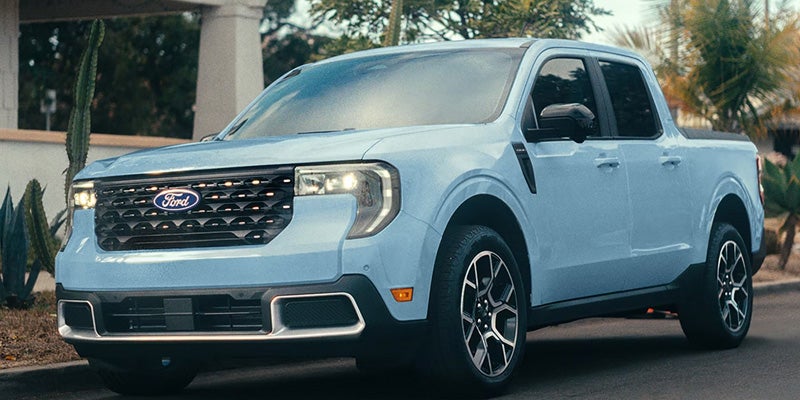
Light blue Ford Maverick parked outdoors near a residential area
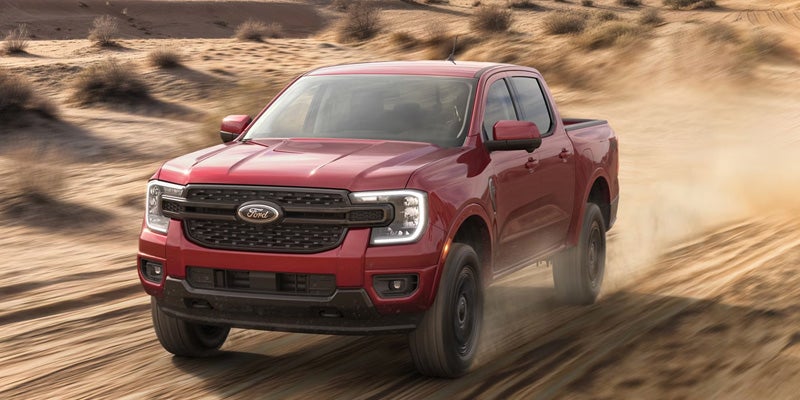
Red Ford Ranger driving on a dirt trail with dust behind it

The Maverick® and Ranger® occupy similar space in Ford's showroom, but they're built around very different ideas. One starts with the question, "What if a pickup worked brilliantly as an everyday vehicle?" The other asks, "How much capability can we pack into a midsize truck without making it feel oversized?" Both answers are compelling. The better choice simply depends on what you expect from your truck once the novelty of ownership wears off.

Daily Driving: Compact Convenience or Traditional Pickup?

The Maverick® is the easier truck to live with if most of your driving happens around town. Its compact footprint slips comfortably into parking garages, grocery store parking spaces, and busy suburban streets, making it feel much closer to a crossover than a traditional pickup. Yet it still offers the open cargo bed that makes hauling landscaping supplies, bicycles, furniture, or weekend projects refreshingly simple.

The Ranger® approaches everyday driving from a different perspective. Its larger dimensions, longer available bed, and more substantial stance give it the versatility expected from a traditional midsize pickup. Drivers who routinely carry work equipment, tow trailers, or spend time on job sites will appreciate the extra space every time they load it.

Capability: Choose the Truck That Matches the Job

Capability is where the Ranger® begins to stretch its legs. Every Ranger® comes standard with a 270 hp 2.3L EcoBoost® engine producing 310 lbs. ft. of torque, while the available 2.7L EcoBoost® V6 raises output to 315 hp and 400 lbs. ft. of torque. Properly equipped models tow up to 7,500 lbs., making the Ranger® well suited for larger boats, campers, utility trailers, and work equipment.

The Maverick® takes a different approach. Standard models feature a 2.5L Full Hybrid powertrain that can tow up to 2,000 lbs., making it an efficient choice for everyday driving. Buyers wanting additional capability can choose the available 250 hp 2.0L EcoBoost® engine producing 280 lbs. ft. of torque. Equipped with the available 4K Tow Package, the Maverick® increases maximum towing capacity to 4,000 lbs.—plenty for many small campers, personal watercraft, utility trailers, and lightweight boats. For occasional towing, that's often all many owners will ever need.

Recognition That Matters

The Maverick® has enjoyed an exceptional year. The Maverick Lobo earned the prestigious 2026 North American Truck of the Year™ title, while the Maverick lineup also received the 2026 MotorTrend Truck of the Year® award. Those honors reflect just how successfully Ford has reimagined what a compact pickup can be.

The Ranger® doesn't rely on awards quite as heavily. Its reputation has been built through capability, durability, and the confidence that comes from delivering traditional truck performance in a more manageable size.

Technology That Keeps Pace

Both trucks benefit from many of Ford's latest technologies, so neither feels like a compromise inside the cabin. Available Ford Co-Pilot360® includes driver-assistance features such as Pre-Collision Assist® with Automatic Emergency Braking, while available BlueCruise® can reduce fatigue during long highway journeys on compatible roads. The available Ford Connectivity Package adds Connected Navigation, Wi-Fi® hotspot capability, voice assistance, media streaming, and connected services that make commuting and travelling noticeably easier. Drivers comparing these pickups should explore our available Ford Maverick® and Ford Ranger® inventory to experience the differences firsthand.

Which Truck Fits Your Life?

The Maverick® is ideal for drivers who want the practicality of a pickup without the size or fuel demands of a traditional truck. The Ranger® rewards owners who regularly tow heavier trailers, carry larger loads, or simply prefer the capability and confidence that come with a midsize pickup. Whichever direction you choose, you're buying from a brand recognized as America's Most Awarded Brand for new-vehicle quality by J.D. Power in 2025.

Compare Both at Platinum Ford

Choosing between the Maverick® and Ranger® isn't about deciding which truck is better—it's about deciding which one works harder for your lifestyle. Visit Platinum Ford in Terrell, TX, to compare both models, take a test drive, and find the pickup that fits the way you drive every day.

Posted in:

Related Posts

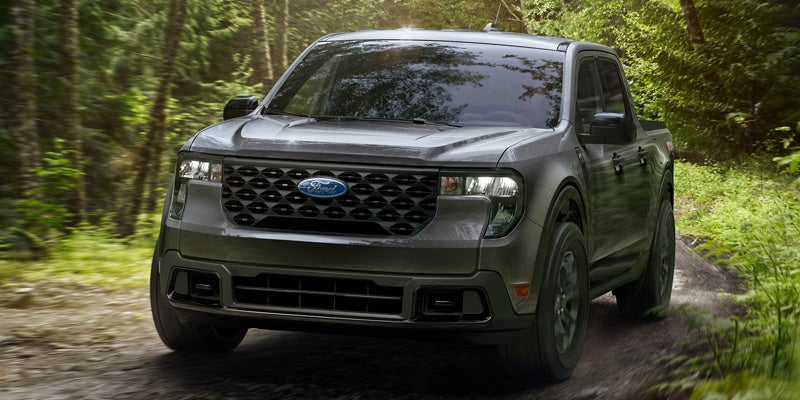
Front view of a gray Ford Maverick truck driving on a narrow forest trail, surrounded by dense green trees and foliage, highlighting off-road capability.

Ford Maverick vs Ford Ranger: Which Compact Truck Fits Your Needs?

Welcome to the ultimate truck showdown. If you are comparing the Ford Maverick and the Ford Ranger to find your perfect pickup, Platinum Ford in Terrell, TX, is here to help. Reach out to our team today to explore these exceptional models and discover the one that matches your lifestyle. The Ford Maverick vs Ford R a nger debate is a common question for modern truck shoppers. Both are highly capable and well-equipped, but they serve different driving needs. If you are hauling gear on the weekend, navigating a busy city, or seeking a vehicle that simplifies daily life, understanding this comparison is the first step. Size and Daily Drivability The most notable difference between the Ford Maverick and the Ford Ranger is size. The Maverick is a compact, unibody truck designed to drive like a car. It easily navigates parking garages and tight city streets without the bulk of a traditional truck. The Ranger is a midsize body-on-frame pickup. It is larger and provides a traditional truck feel, making it ideal for drivers who encounter tough conditions or heavy workloads. For those splitting time between town and rugged terrain, the Ranger delivers robust durability. more Towing and Payload Capability When capability is the priority, the Ranger takes the lead. It is engineered for demanding work and offers a higher towing and payload capacity than the Maverick. Drivers who frequently pull trailers or heavy equipment will appreciate the added strength of the Ranger. The Maverick still handles moderate hauling effortlessly. Its truck bed easily manages home improvement runs and weekend gear. If your needs are light-duty, the Maverick provides excellent utility without the extra footprint, a major reason it earned the MotorTrend 2026 Truck of the Year award. Fuel Efficiency and Powertrains The powertrain options highlight a key distinction between these models. The Maverick features a highly efficient available 2.5L hybrid powertrain, achieving an EPA-estimated 42 mpg in the city. This makes it one of the most fuel-efficient trucks available, perfect for daily commuting. The Ranger focuses on performance and pure power. If you prioritize maximum fuel savings, the Maverick hybrid system is a clear winner. If you need robust output for heavy towing, the Ranger provides the necessary force. Features, Tech, and Comfort Both trucks feature modern technology, including standard Apple CarPlay©, Android Auto©, and available Ford Co-Pilot360© safety features. The Maverick cabin is designed for practicality, utilizing smart storage solutions within a compact space. The Ranger offers a larger interior, providing enhanced comfort for passengers on long drives. Both vehicles deliver a connected and confident driving experience. Find Your Truck at Platinum Ford The best way to settle the Maverick vs Ranger debate is to experience both models in person. Stop by Platinum Ford in Terrell, TX, to explore our current inventory and test drive these impressive trucks. Our team is ready to help you find your ideal pickup, so view our current offers online at platinumford.com.

Road sign with "Buy Car" and "Lease Car" directions against a blue sky with clouds.

Understanding Ford Credit: Lease vs. Finance on Your Next Ford in Terrell, TX

So, you’ve decided to buy a new ford. Congratulations, you’ve made a great decision. Now, you need to figure out how you’re going to pay for it. Are you going to finance it or lease it? Understanding Ford Credit and the difference between leasing and financing will help you choose the option that best fits your budget, lifestyle, and long-term goals. No matter if you’ re eyeing a capable F-150 or a versatile Ford SUV, knowing your options before you shop makes the whole process a lot smoother. What Is Ford Credit? Ford Credit is Ford's in-house financing arm, and it offers both lease and finance programs designed to give customers flexible ways to get into a new vehicle. Through Ford Credit, you can work with your dealership to structure a payment plan that fits your needs without having to go through a third-party lender. Understanding Ford Credit programs is a great starting point before you commit to anything, especially since terms and available offers can vary based on your location and credit profile. How Ford Financing Works When you finance a Ford, you are taking out a loan to purchase the vehicle outright. You make monthly payments over a set term, and once the loan is paid off, you own the vehicle free and clear. This option typically makes sense if you plan to keep your vehicle for several years, want to customize it, or prefer not to worry about mileage limits. Financing often results in a higher monthly payment compared to leasing, but you are building equity in a car you will own. Ford Credit financing can be applied to most new Ford vehicles, and your dealership can walk you through current rate options and available terms. Drivers who put a lot of miles on their vehicles each year tend to find financing to be the more practical choice over time. How Ford Leasing Works Leasing through Ford Credit works differently. Instead of purchasing the vehicle, you are essentially paying for the use of it over a set period, typically two to three years. At the end of the lease, you return the vehicle and can choose to lease or buy a new one. Lease payments are generally lower than finance payments because you are only covering the vehicle's depreciation during the lease term, not its full value. Leasing is often a good fit for drivers who enjoy having the latest technology and features and prefer switching to a newer model every few years. Keep in mind that leases come with mileage limits and guidelines around wear and use, so it is important to understand those terms before signing to prevent any surprises at the end of your term. Lease vs. Finance: Which Is Right for You? Choosing between leasing and financing really comes down to your personal priorities. If ownership, flexibility, and long-term value are important to you, financing is likely the better route. If you prefer lower monthly payments, love driving the newest models, and do not exceed average mileage, leasing may be the smarter move. Ford Credit makes it easy to explore both options through tools like the Build and Price feature on ford.com, where you can personalize a vehicle and get a sense of what fits your budget. You can also pre-qualify online to understand your budget before visiting the lot, with zero impact to your credit score. Visit Platinum Ford in Terrell, TX No matter which direction you lean, the team at Platinum Ford is ready to help you explore your options and find a payment plan that works for you. Understanding Ford Credit is just the first step - getting into the right vehicle is the goal. Stop by Platinum Ford or visit us online at platinumford.com to browse current inventory, explore available offers, and take the next step toward your new Ford.

Automotive technicians inspecting and servicing vehicles inside a Ford service center.

Ford Maintenance Schedule Explained: What Happens at 30k, 60k, and 100k Miles?

Keeping up with your Ford's maintenance schedule is one of the simplest ways to protect your investment and avoid costly repairs down the road. Whether you're driving a new F-150 or a well-loved Expedition around Terrell, Texas, understanding what service your vehicle needs - and when - makes a real difference in how long it lasts and how well it performs. What Is a Ford Maintenance Schedule? A Ford maintenance schedule is a recommended timeline of service intervals based on mileage. Ford engineers these intervals to keep your vehicle running safely and efficiently from the day you drive it off the lot. Following the schedule helps you stay ahead of wear and tear before small issues turn into bigger problems. Each milestone covers a different set of services. Some are simple and routine, while others involve more comprehensive inspections and part replacements. Knowing what to expect at each stage helps you plan ahead and budget accordingly. What Happens at 30,000 Miles? The 30,000-mile mark is an important early checkpoint in the Ford maintenance schedule. At this stage, you can generally expect a thorough inspection of key systems and some replacements depending on how and where you drive. Common services at 30,000 miles include engine air filter replacement, fuel filter inspection, tire rotation, brake inspection, and a check of all fluid levels including coolant, transmission fluid, and brake fluid. If you haven't replaced your cabin air filter recently, this is also a good time to take care of it. For drivers in Terrell, TX, who deal with dusty roads and warm temperatures, staying on top of these items is especially worthwhile. What Happens at 60,000 Miles? The 60,000-mile service is often considered a mid-life checkup for your Ford. At this point, several components have experienced significant use and may be approaching the end of their recommended service life. At this interval, you should expect a spark plug replacement, which can have a noticeable impact on engine performance and fuel efficiency. Brake pads may need to be replaced depending on wear, and brake fluid should be inspected or changed. Your technician will also check the serpentine belt, coolant system, and transmission fluid. It is a good idea to review your tire tread depth and alignment as well. Following the Ford maintenance schedule at this stage helps ensure your vehicle stays reliable well beyond the 100,000-mile mark. What Happens at 100,000 Miles? Reaching 100,000 miles is a milestone worth celebrating - and servicing properly. At this point in the Ford maintenance schedule, a more comprehensive review of your vehicle's major systems is recommended. Coolant replacement is often due at this interval, along with a fresh look at spark plugs if not already addressed. Your technician should inspect the timing chain or belt, check for any signs of oil leaks, and evaluate the condition of hoses, belts, and suspension components. Transmission service may also be recommended depending on your driving habits and fluid condition. Taking care of these items helps keep your Ford performing the way it was designed to. Why Staying on Schedule is Important Consistent maintenance does more than prevent breakdowns. It preserves your vehicle's resale value, helps identify potential issues early, and keeps your Ford running with the efficiency and reliability it was built to deliver. Ford Mobile Service and Ford Pickup and Delivery options make it easier than ever to stay on top of your schedule without disrupting your day. Visit Platinum Ford in Terrell, TX So, if you're approaching 30,000 miles or well past 100,000, sticking to the Ford maintenance schedule is one of the best things you can do for your vehicle. The team at Platinum Ford in Terrell, TX, is ready to help you stay on track. Schedule your next service appointment and drive with confidence knowing your Ford is being taken care of the right way.

New Used